

Biota
biota
The organisms that occupy a place,
habitat or time together
Marine, terrestrial, digital, living or dead(Asymmetrical / symmetrical)
—Joel Ephraims, Biota (back cover)
This is a glimpse of a video landscape of tomorrow when you will be able to switch on any TV station on the earth and TV guides will be as fat as the Manhattan telephone book.
—Nam June Paik, Global Groove (1973)
I read Biota as a Nam June Paik electro-colour video poem, with ghostlike figures brought forth in fluorescent pink and yellow highlighter, dancing across a screen to Technotronic’s ‘Pump Up the Jam’ while a shower of stars and moon travel gently across the sky. Just when you’ve momentarily found peace in poetic image, it’s interrupted: a jukebox jumps “from the highest window / into its own / frightened or excited / applause” (11). “It’s like that when we cascade / into most places” Ephraims writes (11), and it’s true: moving as a subject through the biosphere, nowadays, is an eclectic experience mediated by the hyperreal, self-reflexive presence of the digital, which in this collection, warps and bows as it engulfs human bodies, “ground dwellers, space dwellers, sky dwellers” (63)—indeed all organisms, whether internet, fantasy, living, past, future, or dead—this is biota.
Enmeshed by every TV station on earth—that is, billions of Instagram accounts, Twitter adversaries and information news waves, Ephraims’ poems channel the reader like radio, through verses which crackle with global and local frequencies, all at once and “at warpspeed / and crawlspeed” (25). Ephraims’ hyperaware super consciousness is simultaneously “bogged up in a caterwaul / of screens of the same elk” while unhesitatingly moving us beyond linguistic limits through a compound and gerund-rich text (17): “star-yolk treading / the zero-gravity, horizon-brushing / canopy grass” (25). Like the internet, consciousness is excessive and everywhere.
In Ephraims’ poems, consciousness is alert and sensitive to both humans and the non-human world, and their nuanced relations, whether spiders, bees or “white gleam seagulls” on an “auto-watered lawn” (101). Machine, man and animal mingle, but not always harmoniously; there’s a sterility in the modern human condition, aptly captured like gulls on an auto-watered lawn—in Ephraims’ vision, technology has distanced us from the non-human other. And, contrary to widespread belief, it isn’t always ‘man’ that dominates the biosphere; Ephraims writes to subvert anthropocentric hierarchy, as in the “great whites / that dwarf / speed boats” (93).
This collection subverts the singular human ego in favour of multiplicity and connectivity between organisms:
Not caught, but unfolding,
(21)
we rotate on hydraulic steam,
not vacuous but fielded
with effulgent animals we tend,
who tug us forward on the steam
which emanates from our halves
and dissipates beyond our spheres.
Tugged forward alongside our animal parts, we the reader move within the steam of earth’s cycles, and then, with the applied pressure of a hydraulic system, shift from the relative knowability of the biosphere into the excess of a capitalist technosphere characterised by social inequality and hunger. The collection opens with an image of a homeless man, “an inedible grey cabbage / flicked onto everyone else’s plate”, who is unpalatable and without anything to eat (11). In contrast, Zuckerberg, whose net-worth sits at 57.7 billion USD (LaFranco and Peterson-Withorn 1), is one of those multi-billionaire ghosts spleening “a buck / for every heartbeat” (43)—“hotel hungry, / opalescent beach famished” (23) and consequentially, consuming everything—“The various dragons’ / arse cheeks have settled / on the conglomerate aura / of their treasure” (124).
Ephraims writes to resist capitalist engulfment, musing:
The poems are houses.
(Preface)
The tiny poems are shrines.
…
Shrines are places to leave nourishment for dead souls
so they don’t fall into a deep hunger and die
a second death to be reborn as hungry ghosts—
lost souls of eternal hunger.
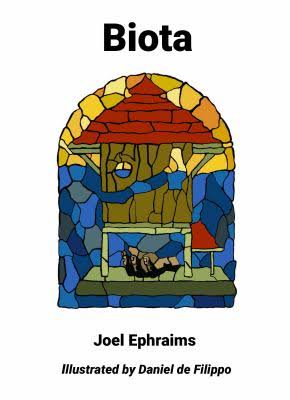
Traversing across both Vietnam and Australia, these shrines nourish while keeping the (excessively hungry) ghosts at bay; as Biota illustrator Daniel de Filippo writes: “In traditional Vietnamese folklore … shrines are an essential vessel for the sustenance of the hungry ghosts who shadow the lives of the living” (131). While Ephraims’ poems are pastiched, multi-layered and non-linear, in contrast, de Filippo’s visual translations of these works are strikingly simple line drawings which succeed in maintaining the surrealistic element of surprise which glows resplendent in Ephraims’ poetry.
Collaboration between the poet and artist can be read as an ecological act in itself; translation from word to image requires empathy, deep-thought and mutual permeability to successfully develop and extend each art-form. This collaboration drew the subjects from their physical and digital isolation through much of Sydney’s Covid-19 lockdown: “In assembling these shrines, from traditional ink draft to digital fine artwork, we stayed connected—Zoom ghosts nourished for thirty days,” de Filippo writes (131). Just as Ephraims’ poems mimic mycelium in their fabrication of a network of connectivity between culture, technology and nature, co-creation of the book itself worked to combat isolation through humble listening, dwelling and responding.
But there is deep intention behind the crafting of Ephraims’ poems; self-referentially they repeatedly make clear a hankering to do more than just “itch & buzz” among the Australian poetry scene:
… I want to blimp
(19-20)
over the football stadiums,
remarkable odd-shock
involuntarily noticed—
I’ve got to carve out
prize horse canter, fish-hook
careerism & dump gutted
lava over child-like awe—
I’ve melted the fourth wall,
good, there’s myriad others
left made up of substances
as alien as water
is to light—it’s in
the oldest ice cores
we can see ourselves
most clearly reflected
Ephraims’ work is repeatedly caught up in the question of poetry and what it can do for human consciousness, for society and for Earth. His poetic endeavour is fractal and complex; it makes fun of the over-arching concerns of capitalism (lest we forget Berejiklian’s near $1 billion blow-out on a football stadium) while challenging linear conventions and dragging the reader involuntarily into the fabric of the poem, to be represented and to look—as if in a mirror, through light, through water, to Earth’s ancient core, where we vibrate, most clearly ourselves.
The poet’s work then is to resist capitalism, unearth colonial and anthropocentric legacies and oppose violence, all through play: an eternal splicing of the human subject “crescendoing, plateauing melodies / leaving, seeking Earth-pace” (126). But it isn’t an easy undertaking, Ephraims admits: “It has cost me many skins to build my helixing staircases / through its ice-lash tails” (111). If reading his poems we are rendered “like cornered animals / in cages of strobe cloud” (35), it’s because his writing mimics the experience of postmodern living within a hyperrealist showdown of “sleeping and walking and sleeping” (48), bombarded by violent imagery and realities across unpredictable time and space: “the Internet / plasma TVs, Second Intifada, / Obama, Momo, Covid19, George Floyd” (48). It’s a lot to unpack for both writer and reader, and consequentially, the poems are dense and topical. In ‘The Fires’ Ephraims critiques the two-party system in the shadow of Sydney’s horrific Black Fire Summer: “The koalas, ultimately, / could be expendable” (90). In ‘(Neo) Isolate Corona’ Ephraims catalogues the political horrors of the pandemic period re: Barilaro, Gladys, vaccines and the Aukus submarine deal (70).
These are poems which smoulder with class anger—“drones for the rich, / kites for the poor” (55)—and which are stylistically as self-referential and difficult as living in the internet age whilst confined by the unbearable and hungry “burden of the technosphere” (Zalasiewicz 1):
The poets
(121)
make unique games
as a profession
and suffer trouble
of plastic, mass-produced hands
pushing down
on the dance
inside their heads.
Ephraims’ repeated emphasis on doing more “in an algorithmic world of rushing figures” betrays a definite undertone of futility regarding the position of poetry in a fucked up world (74). In stark moments, read alone and late at night in a cramped and stuffy Newtown bedroom, his voice rings loudly—oh so loudly, and piercing: “I Feel Like An Echo Chamber Unto Myself” (59).
And yet, ultimately, the book succeeds in that which—I read—it set out to do: to write us toward ourselves while drawing us always outside ourselves (and our impervious and reflective iPhone screens). Biota tumbles—a surrealistic stream of obfuscated intelligibility—to emerge from the depths of its own self-reckoning (“I don’t know what it is / but it’s doing something to me, so– ” [58]) as strikingly oppositional and empowered:
Star system rises
(58)
from computer chair—
gravity irons pleated creases—
star-vines lantern and world.
In another era, Hölderlin famously posited a question which was taken up most recently by Sydney eco-poet Kate Fagan, who asks: “What is the use of poets in a bereft time?” (27). In Biota, Ephraims’ works resonate a reason for poetry: “first of all, to get by” (128), and secondly (and Ephraims writes this, I’m sure, not without a touch of irony), that “when enough cells pressure, / money willing, they’ll seamlessly change” (120). There’s a level of anticipation for transformation through capitalism, supported by a movement in poetry. Biota, written through the confines of the pandemic—alongside innumerable other catastrophes and tragedies—proves its own worth through its playfulness, even when it reads chaotically. An ecstatic collision of spiralling imagery, digital exploration and resistance, Biota radiates with an energy and lust for a different version of life on earth; one that, like a “bright blue marble” (14), is shiny with hope and—like the universe—infinitely expansive and revelatory.
