
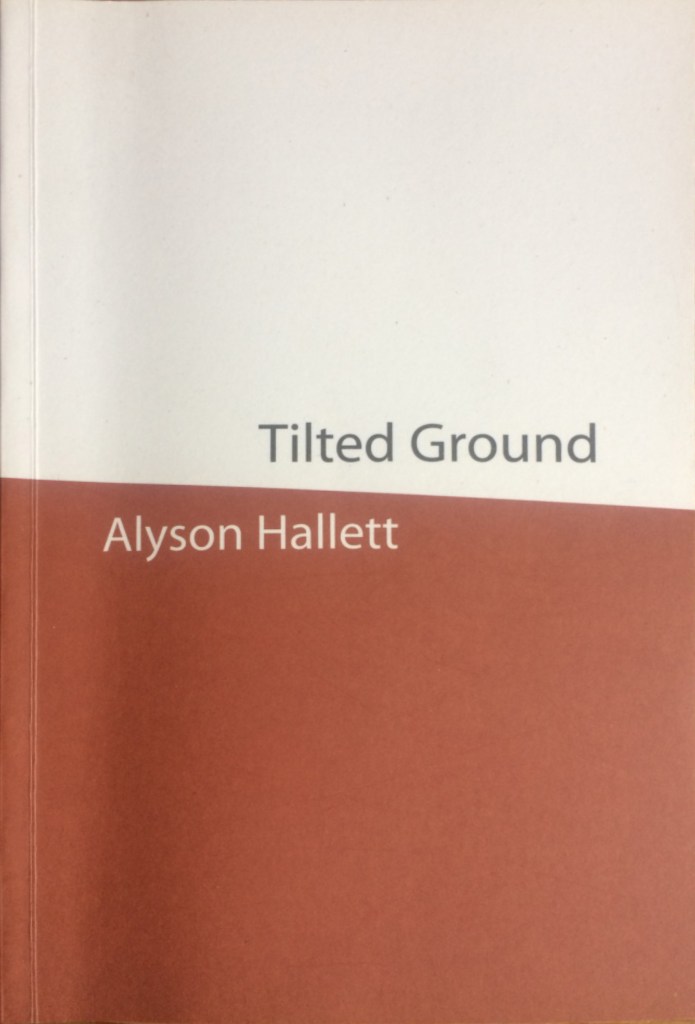
Tilted Ground
Alyson Hallett is an award-winning British poet who has published solo collections of poetry as well as collaborations with fellow poets, scientists, and a walking artist. Her PhD research centred around the idea of geographical intimacy, and the politics and poetics of land/language inform the heart of her work. She's written short stories, drama, and an essay for BBC radio, and for the past twenty years she's curated her international poetry and public art project, The Migration Habits of Stones. It involves carrying stones around the world with a line of poetry carved into them and embedding them in public spaces (including a stone in Kanahooka Park, Wollongong).
In 2019, Alyson Hallett was poet in residence at the Lyell Centre in Edinburgh, run by the British Geological Survey and Heriot-Watt University, which brings together experts in land and marine conservation, geology, and geoscience. She was commissioned to write three poems, engage with the university, learn about carbon storage, and go on a geological field trip to Kirkcaldy. Out of this commission came an entire book.
For Hallett this was an ideal opportunity. It combined exposure to dense scientific knowledge with her existing interest in rocks and stones which “invite dynamic encounter” and are the origins of our world and ourselves (9). As Hallett notes, “When I am with a stone, I am with my oldest ancestor” (9). The deep time of geology fascinates her, and geologists have a grasp on time frames that most of us find mind boggling. Fossils are crucial too, and human beings add another layer to the skeletal remains in rock: “skeleton creatures that have lived before us and tell us we too will also be a layer in a rock one day” (9). She is also interested in the magnetic properties of rock, the solar system, and the human brain. The excitement of discovery reminds me of Ada Lovelace’s writings and the limitless scientific discoveries of the nineteenth century.
Hallett sees analogies between the hidden rocks, their life forms, and the unconscious mind. Her time at the Lyell Centre coincided with the anniversary of her father’s death and in the collection many painful memories resurface. She decided to work with her grief: “As a writer I’m interested in aligning what’s inside with what’s outside, allowing a messy congruence, multiple points of view, situating the human being with nature rather than above, beyond, outwith” (9).
An attractive aspect of Tilted Ground is the way quotations on rock and stones are juxtaposed with the poems. Hallett comments in her introduction that “every writer is part of a writing community” (10). For Hallett, her community includes the poets Peter Redgrove and Penelope Shuttle, based in Cornwall, outside English post-war poetry of irony and limitation and closely allied to European poetics, especially surrealism. She shares their interest in mythic possibility and animism, often in contrast to the scientists at the Lyell Centre.
The first section, ‘Heritage’, is a series of poems about Heriot-Watt University and her own deepening understanding of geology and the landscape around her, as she learns of its historic layers and geological significance. It opens with a statement about rock: “this is where our language comes from / mother father glamour bed” (16). She explains that the word ‘glamour’ was originally a Scottish alteration of ‘grammar’, and it meant magic, enchantment, or spell. She also thinks about Heriot-Watt’s female figures and searches in vain for a statue of Mary Burton, education and social reformer, who won women the right of entry to the university and became one of its governors. There is also an economical and playful homage to Muriel Spark who did a course in precis writing, which has her as a “spark / in / the /dark”, a “brief / flint / on / flint” (23).
‘In the Core Store’ creates variations on a visit to a room of rows of rock cores. Her explorations are not without a certain black comedy, especially when she asks people to lie down at the end of a row of rock samples and, without discussing it, they know that they are enacting their own dissolution: “They lie on / the tables and smile / and fold their arms / and even though / we don’t talk / about femurs and fibias / dissolving in silt we / know without doubt / that’s what we’re / not talking about –’ (29).
In ‘Cores: 3’ the theme of ‘geology and the unconscious’ reminded me of surrealist artist Meret Oppenheim’s 1938 painting ‘Femme-pierre’ (‘Stone Woman’), which shows a woman made of stones with her legs in the water, representing for Oppenheim a connection with the unconscious (Presley 130, Curiger 44):
instinctive mirrors
(30)
geology and the unconscious
a moon in a shallow puddle
a ninety foot tree in a bucket
As someone who lives opposite ‘Stonenest street’, and has often played variations of the name, I enjoyed ‘Cores: 5’:
stone
neststone
eggstone
(33)
hatch
The section ‘Wellbeing’ is an alternative take on the clichés of corporate university student welfare speak. It begins conventionally, in ‘Departures’, with “Come in, you’re welcome here” (39), but then shows us Marina Abromović’s disturbing ‘Shoes for Departure’ (1991), made of amethyst. Inevitably we think of the little mermaid, both in Hans Anderson and Simone de Beauvoir (615), yet these shoes, though impractical, are empowering. What matters are “Walking feet / and walking stones”, however painful: “Blisters and facets. Shoes / that let the light come squinting / through your toes” (39). I read ‘Departures’ one morning when I was out on a boulder beach—the soles of my feet tipped and trapped by the rocks. It was a deep massage, which is almost a flaying, and at night I could feel the stones pummelling my feet. Feminism is refreshingly explicit in ‘Carbon’: “Sometimes she’s an alien. / A woman in a torrent of men … how the Earth / feels when it’s pumped full / of someone else’s CO2” (42).
‘Words Carved in Stone’ is a discussion of a carved stone, public art, inscribed with words by Robert Burns and Alex Salmond. It’s an art form that Hallett has engaged with, so was drawn to observing other examples. In this case she is rightly critical of combining a poet’s words with those of a politician, who was then on trial for sexual misconduct, even though those charges were dropped: “Better by far to let the poet have their say” (44).
‘Geo-ethics and Syllabus’ plays with the form of the conventional university syllabus in various ways. It includes a series of poems called ‘Universal Syllabus’, which subvert the syllabus format with policy statements, instructions to students and questions for them to consider, which would never be found in any scientific syllabus. For example, in the lines: “We are promoting a policy of gratitude first, analysis second” (58).
‘Plume of my Seismic Time-Lapse Dreams’ samples a technical monitoring study, which she turns into a ‘lullaby’: “It was a seismic / time-lapse lullaby” (51). Each two-line verse begins with a sample of technical language juxtaposed with her own following line: “Baseline predictive models evolved / through evenings of whisky and wine” (51). Some scientists would hate this combination of scientific fact and poetic experience, a common Surrealist practice, but Hallett shows how the two realms of knowledge and discourse can interact.
Another intriguing poem from this section is ‘The Third Direction’, a series of two-line verses in which a statement in one line of verse is contradicted in the next:
There was no time.
There was a lot of time.Fluids were stable.
Fluids were unstable.Models made accurate predictions.
(57)
Inaccurate predictions.
Hallett explains that the idea of the ‘Third Direction’ came from David Bohm, the quantum physicist, and the notion of wholeness in which a two directional spin would create a third direction. A notion which is implicitly pursued through the poem itself.
‘Field Trip: Kirkcaldy, Fife’ is perhaps the most interesting section of all. The short, slender poem, ‘little slump’, consists of geological terms which are fascinating in themselves, such as “aeolian sandstone”, caused by wind-blown sand dunes, the fine layers of “laminae”, and the final “little slump” itself (68). The application of specialist terminology reveals its metaphoric inevitability.
In a departure from the syllabus, Hallett includes a poem of mourning for her father: ‘Two Herons’, although it too has some geological permanence in its metaphor: “two herons / sedimented // two arcs of grey / on cloudless blue” (71). It’s another of her two-line verse poems and, although I dislike constraints if they serve no purpose except ‘poetic’ patterning, most of hers justify their inclusion. The grammatical distortion in the second half of the poem correlates with the abrupt grief of death: “not the hunched heron / I saw the day // my father died” (71).
The theory of tilt is fundamental to geology. At Glen Tilt, in the eighteenth century, James Hutton found evidence that heat from within the Earth was responsible for lifting rocks from beneath the sea onto the land. Hallett uses geological terms and names of fossils from the earliest life forms in her own poem titled ‘Tilt’:
unwound nautilus
(73)
marine beds
delta plane
tilt
The precise language is unvarnished and each verse ends with the imperative “tilt”, repeated three times at the end with a tilt or forward slash for punctuation: “tilt/ tilt/ tilt” (73). Life forms develop from bacteria to jellyfish, from drifting plankton towards agency and control. One of these is the tiny “crinoid” whose name comes from ‘crinon’ or lily, yet it has a mouth and body and attaches itself to the seabed with a stalk. The verse itself is minimal and yet resilient:
back bone
(75)
of a sea lily
stashed in rock
little song
that can’t stop singing
For Hallett the rocks themselves become sensate in ‘Late lunch in the Baker’s Field, Kirkcaldy’: “They felt the tickle of feet / on their ribs, sensed / waves of sound float down” (77). Hallett has taken us so deep into geology and the formation of life that we are inclined to accept this simple animation and movement: “The rocks continued to rise. / To lift their crags towards the moon” (77).
The prose poem, ‘Stone vs Rock’, consists of a single sentence and demonstrates how a particular word, with all its associations, rather than exact terminology, has primacy in poetry and achieves the necessary effect:
The geologist tries to persuade the poet of the correctness of using rock instead of stone but she’s not sure she can give up the softness of stone, the sibilance, the undercurrent of bone and home, the way the word rounds on itself (…) not sure she can put correctness above love of a word and the way knowing it might be wrong makes the line tilt, as if it too has been subject to tectonic pressure.
(78)
You can almost see the line tilting, as it does in her collaborations with the stone carver Alec Peever (Studies). Another poem, ‘Blaze’, recounts a field trip to the Firth of Forth in which ancient geology makes words and sounds even though it “can’t be heard” (80). We are returned to the “coral colonies” with their crinoids and ossicles (80). Ossicles are both small bones in these early forms of ocean life and bones that our found in our inner ear. The geology gets louder as “a petrified river / rattled to the sea, stratified so absurdly // it combed the mind and parted it” (80). It resonates in the body of the poet.
The end poems, ‘P.S’ and ‘P.P.S’, include ‘Friday’, when one night “she dissolved into rock”, and the “fine quartz grains grazed against her skin” and dug their way deeper into “the reservoir of her body” (84). The fossilized river of red, ochre, and yellow became liquid and “swam to life inside her”:
When morning came, she poured herself
(84)
into her shoes and moved through the city
in a series of inconsequential waves
We recall the shoes of Marina Abramović, but these shoes allow for a new ease of movement, the body moving in harmony with the rock, the body as the rock. ‘The Lily in the Stone’ describes a tiny pebble found in her pocket, a present from a field trip, which has the white ridge of a crinoid or stem of a sea lily. Her observation is confined to short lines, perhaps the shape of a lily stem. It ends with a mantra, which is also a scientific truth: “praise be for random / synchronous complexity” (86).
Works Cited
Curiger, Bice. Meret Oppenheim: Defiance in the Face of Freedom. The MIT Press, 1989.
Presley, Frances. “Imago.” Collected Poems. Shearsman, 2022.
De Beauvoir, Simone. The Second Sex. Translated by H. M. Parshley, Bantam, 1953.
Hallett, Alyson. Studies in Light, Language, Stone. <www.thestonelibrary.com>.
