
Cosmological Readings of Contemporary Australian Literature: Unsettling the Anthropocene
It is an enormous task to make people conscious of themselves within their own history. And yet, it is actually also a limited undertaking – indeed, a kind of renunciation – if we consider that we live not just on the earth, but in the world, in the universe.
– Eric Auerbach
(264)
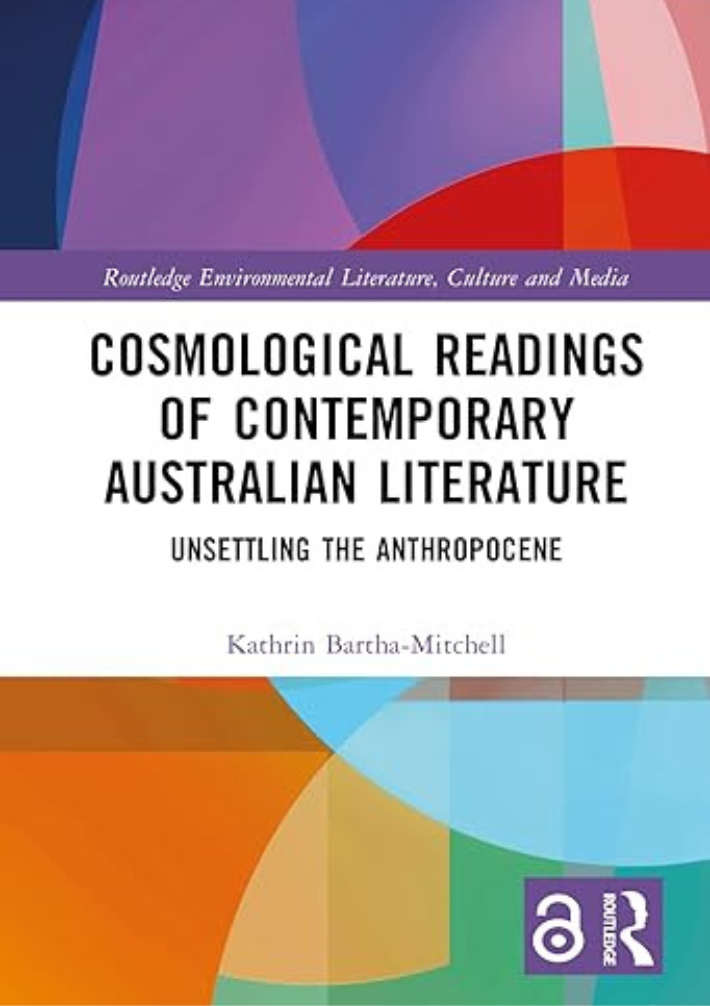
Writing in 1952, German historian and philologist Eric Auerbach argued for breaking up the divisions of Cold War politics through a cosmological vision of world literary studies, a vision in debt to Goethe’s weltliteratur. In its incisive arguments for a transcultural, modern, disenchanted cosmos, Kathrin Bartha-Mitchell’s recent book, Cosmological Readings of Contemporary Australian Literature: Unsettling the Anthropocene (2023) argues for a similar rescaling of our attention on a changing planet. Bartha-Mitchell places Cosmological Readings in a ‘third wave’ of environmental literary studies, following the ecocritical turn in Auerbach’s Cold War period, a turn to the global in the environmentalism of the early 2000s, and the current “transcultural turn” which seeks “to overcome the limiting, isolating focus on specific cultures as unique phenomena” (Slovic 4).
Cosmological Readings provides a refreshing approach to the political exhaustion of environmental concepts, often mired in debates over whether particular terms “are now ‘in’ and ‘out’, ‘hip’ or ‘not.’” (xii). Rather than reiterate a familiar division of human and nature, Bartha-Mitchell offers as a counter-example in the cosmos, “a vast array of individual, cultural and more than human phenomena”, comprising “procreation and evolution, a sympathetic order, mysterious soul, the planetary and the universe, and ethics and politics” (1). The cosmos’ linguistic origins from the Greek kosmos connotes both order and disorder, capturing human entanglement and emplacement in destructive and life-giving changes in our climate.
Cosmological Readings' transcultural focus juxtaposes past and present to create striking relations between ancestral narrative traditions, earthbound religious and cultural practices, all as presented in contemporary literary texts. The book is structured around thoughtful pairings that allow Bartha to align disparate visions of the cosmos together in a spiralling pattern that reflects the constitutive opposition contained within the term: the opposition of cosmos (order) and xamos (disorder).
Cosmological Readings' cosmophilic commitment to provide new perspectives of our relation to the planet and the universe is by no means naive. Noting literature’s “special aptitude” for presenting “the Anthropocene predicament in meaningful ways to bind individual readers into larger, more than human collectives” (11), Bartha-Mitchell is incisively engaged with the contradictions and ironies of human behaviour in environmental debates. Attentive to the interplay of “guilt and purity, hope and despair” (190), Bartha-Mitchell recognises the capacity for alarmist or well-meaning narratives to affirm biases or blind perspectives and the siloing of perspectives as exceptional or improbable within universalist perspectives or epistemologies.
Among other examples, the book explores a number of challenging counter perspectives: a critique of island sinking that ironically diminishes its appeal to environmentalists in Briohny Doyle’s novel, This Island Will Sink (2013), a long history of Indigenous agricultural production in Tara June Winch’s novel, The Yield (2019), and asylum seeker environmental justice in Behrouz Boochani’s autobiography, No Friend But The Mountains (2018). These narratives are presented against entangled political histories that encourage a reader to understand a single event through its intersectional meaning to a variety of groups. In the case of Boochani, Bartha-Mitchell reads the novel against the Australian government’s 1992 decision to release colonial interests in the Pacific region in order to refuse refugees the opportunity to seek asylum, the extraction of ‘superphosphate’ from Pacific islands, such as Nauru, the site of a detention centre, alongside the media coverage of Boochani’s Manus Island.
Cosmological Readings moves between disciplines to trace these intersections, taking up critiques of philosophical turns in materialism from Indigenous and postcolonial scholars. This gesture opens the book up to critical debate on the relationship between academic institutionalisation and custodianship. Bartha-Mitchell quotes Maori scholar Brendan Hokowhitu, arguing that the very notion of a ‘turn’ is “only necessary for cultures that turned away from it in the first place,” neglecting a culture “which has long argued for, and developed cultural forms around, material agency” (48). Hokowhitu’s critique parallels a similar response by Wiradjuri scholar Jeanine Leane at the recent “Order and Chaos” conference at Western Sydney University, in which she questioned the uncritical repetition of the term, ‘decolonial’ given its origins in academic contexts rather than community (“Panel: Aboriginal Critiques of Settler-Colonial Epistemological Orders”), or further back, Roberta Sykes’ critique of the use of the term ‘postcolonial’ to refer to Aboriginal literature in Australia, “postcolonial? What? Have they left yet?”.
At times, the book’s theoretical discussion is stretched by the gap between disciplines and temporalities. In an opening section, Bartha-Mitchell foregrounds her contemporary focus to unsettle colonial perspectives, extractionism, and a primitivist conception of the cosmos, stating
a modern conception of cosmos is important because culturally specific ideas of cosmos contain an air of pre-modern paganism.
(48)
The phrase suggests a self-justifying argument, whereby “an air of pre-modern paganism” is taken as a tacitly negative or reductive framework, a framing that anticipates a ready defence against the idealisation of Indigenous cultures in ancestral time. The book’s theoretical framing of the modern as an antidote to primitivism might take into account work by Indigenous scholars who refuse to bifurcate the ancestral and the modern to begin with, such as in Alexis Wright’s discussion of sovereign temporality (“The Ancient Library”) or Jeanine Leane’s discussion of all-times (Guyawu).[1]
Cosmological Readings opens onto richly contextualised discussions of texts on their own terms in the chapters to follow. Bartha-Mitchell gives a more nuanced analysis of the interplay of deep time and the contemporary in Albert Goondiwindi in Winch’s novel, The Yield. Goondiwindi is described in a form of kinship with the wheat often associated with colonial development, which Bartha-Mitchell traces to the archaeological discovery of Wiradjuri people as the first users of grain on the planet, encompassing the “persistence of Indigenous law despite destructive colonial practices” (87). Citing Albert’s capacity to integrate Wiradjuri and Christian beliefs, Bartha-Mitchell writes that the problem with “cross-cultural and at-times clashing cultures” is not in fact, “the diversity of belief systems, but in the rigidity of whitefellas” (87).
Interestingly, many of these texts foreground an island or aquatic space: Doyle’s This Island Will Sink explores the media saturation of islands through Pitcairn Island, Boochani’s horrific surrealism emerges through Manus Island, and Van Neerven’s Water takes place on an imagined island beyond the coast of Queensland, whereas the remaining texts are also situated in relation to estuarine environments, with both Carrie Tiffany’s Everyman’s Rules for Scientific Living and Winch’s The Yield set near the Murrumbidgee River, and Melissa Lucashenko’s novel, Too Much Lip exploring an island in an unnamed river in Southern Queensland. The centrality of island and aquatic environments suggests possible interventions into the blue humanities as well as smaller sub-fields such as island studies. In the space it has, the book does not fully explore the relation to island studies, a field in which several Australian scholars such as Elizabeth McMahon have interrogated the questions of boundedness that defined Australian studies. The book develops these ideas within a fluid ecocritical context, with Granny Ava’s island in the river as an exemplar of a relational landscape:
The river, its flows, as well as “Granny Ava’s island,” are presented to be connective, as they continuously bring the broken family together, giving perspective, and bringing individual and collective healing.
(173)
Bartha-Mitchell associates the river and the island together in “healing potential” and “mobility”. The island and the river foreground temporal and spatial mobilities, as the river mobilises “characters’ memories and emotions” into the ocean, whereas the island links the character Kerry to ancestral memories in movement across time. This, Bartha-Mitchell posits, is not essentialist, but defined by environmental justice and sovereignty, “informed by tradition asl well as by modern family history”, including experiences of “displacement, violence, and ostracism” (173).
Cosmological Readings’ transcultural focus on the cosmos takes an intriguing shape in the opposition of Bundjalung novelist Melissa Lucashenko and Kurdish journalist and filmmaker Behrouz Boochani. Boochani’s No Friend But the Mountains portrays the protagonist asylum seeker’s journey to, and experience of detainment, in the offshore prison centre set up by the Australian and Papua New Guinea governments in Manus Island, blending real events such as the 2014 Manus Riot with fictional composites of other events, many of which were directly witnessed by Boochani. The book draws together documentary prose with poetry and academic discourse, written in translation from Kurdish Farsi to English. Bartha-Mitchell expertly shows that Boochani “presents multiple forms of sovereignties including the sovereignty of animals and human acts of care for people animals and places”, in what she terms, “sovereign acts of custodianship” (166).
Published a year later, Lucashenko’s Too Much Lip also draws on multiple events that blur fiction and realism in their depiction of the simultaneous threats of the “desecration of the family’s sacred river” and “the death of the Salter patriarch, Pop (171). Like Boochani, Lucashenko works with fictional and historical composites, where, as Bartha-Mitchell puts it, “it is the mobility of characters that is the key to winning custodianship” (173). Between these two examples, the book draws out “unique insights into, and critiques of, Australia’s prison industrial complex” (148).
Both authors exert what Bartha-Mitchell calls a “situated knowledge”: “it is here that theories and legislations ‘live’” (148). In many ways, the Boochani-Lucashenko pairing is a brilliant gesture that uncouples the bifurcation of rootedness and rootlessness by which concepts like custodianship are formed. The chapter’s unsettling of symbolic oppositions challenges essentialist constructions of identity and custodianship; where for instance, “custodianship need not exclude complex situatedness” (181).
Occasionally, the book’s capaciousness makes me wonder whether the transcultural connections of the book might be applied further. This is a reflection, rather than a critique of the book’s scope (one can only write so much). While the book comments upon Allen’s concept of trans-Indigenous methodologies to draw connections between Indigenous literary cultures and notes Boochani’s identification as Indigenous Kurdish, the book does not go so far as to think through what a trans-Indigenous connection might mean between the multiple attachments to place represented between Boochani and Lucashenko, given their and their characters’ respective claims to Bundalung and Kurdish Indigeneity respectively.
Such connections would be denied by what Bartha-Mitchell analyses of the Kyriarchy, “the spirit that is sovereign over the detention centre and Australia’s ubiquitous border-industrial complex” (Tofighian xxvii). One also could apply the Kyriarchy further to explore how asylum seekers and Papua New Guinea guards are pit against one another, and to the extent to which concepts of savagery and terrorism determined their relation: as, for instance, in Boochani’s first picture of Manus Island and its inhabitants:
My mind has been moulded by the commentary of the Australian officials – they have spent quite some time forming an image of Manus Island in our minds, a savage image of the people, the culture, the history, the landscape. As a result, I think that Manus must be an island with a warm climate and full of insidious, strange insects. That instead of wearing clothes, the people of Manus cover their sexual organs and waists with broad banana leaves. A few days ago, we were directed to information on the internet about the first humans and it evoked these images in my mind. It is exciting – and sometimes scary – to imagine a life alongside people living that way.
(83)
Boochani also observes that this stereotypical representation is mirrored by the guards’ preconceptions of the asylum seeker as savage. The possibility of recognition and kinship between the two groups is undercut by the Kyriarchy’s enactment of xenophobic and colonialist beliefs. Indigenous and migrant groups have a long, complex history of resistance against settler-colonial institutions.
These connections are honoured by a longstanding activist tradition by which Aboriginal Australian groups have provided Aboriginal passports to asylum seekers, a history Bartha-Mitchell is alert to, quoting South Coast Yuin man Lyle Davis: “I didn’t cede my sovereignty, so I don’t know what gives the white Australian Government the right to say who can or can’t come into this country” (Faa, 2019). The Indigenous Social Justice Association have passed similar passports onto asylum seekers through the last decades; indeed, a year following Boochani’s publication, a freedom flotilla was launched towards Manus Prison containing 400 symbolic Aboriginal 'passports' as part of Sail 4 Justice. These relations present vital intersections in environmental justice movements that unsettle a conventional language of attachment and placehood. In its animation of these rich, intersectional histories of environmental justice, Cosmological Readings renews an Australian cosmocene—modern, transcultural, and disenchanted.
[1] The relation of ancestry and modernity is insightfully analysed by Mark Rifkin in Beyond Settler Time (2018), which draws on Einstein’s theory of relativity to develop the concept of temporal sovereignty.
Works Cited
Araluen, Evelyn, Barry Corr, and Jeanine Leane. “Panel: Aboriginal Critiques of Settler-Colonial Epistemological Orders.” Australian Literary Studies Convention, Western Sydney University, 2 July-5 July 2024. Paper.
Bartha-Mitchell, Kathrin. Cosmological Readings of Contemporary Australian Literature. Routledge, 2023. Boochani, Behrouz. No Friend but the Mountains: Writing from Manus Prison. New South Wales: Pan Macmillan Australia, 2018.
Faa, Marian. “Refugees on Manus to Receive First Nations ‘Passports’ from Activists Aboard Sail Boat.”
ABC Far North, 17 July 2019, https://www.abc.net.au/news/ 2019-07-17/refugees-on-manus-island-to-recieve-aboriginal-passports/11310214. Accessed 10 Oct. 2023.
Rifkin, Mark. Beyond Settler Time: Temporal Sovereignty and Indigenous Self-Determination. Duke University Press, 2018.
Tofighian, Omid. “Translator’s Introduction”. No Friend but the Mountains: Writing from Manus Prison. New South Wales: Pan Macmillan Australia, 2018, pp, xvii-xxvi.
Slovic, Scott. “The Third Wave of Ecocriticism: North American Reflections on the Current Phase of the Discipline.” Ecozon@: European Journal of Literature, Culture and Environment, vol. 1, no. 1, 2010, pp. 4–8.
Leane, Jeanine, editor. Guwayu – for All Times: A Collection of First Nations Poems. Magabala Books, 2020. Wright, Alexis. “The Ancient Library and a Self-Governing Literature.” Sydney Review of Books, June 2019.

