


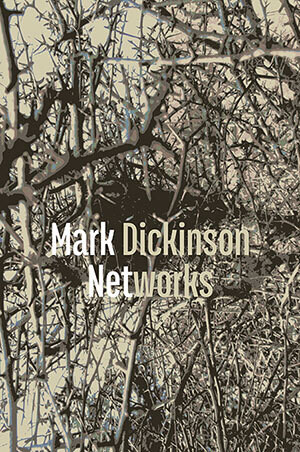
Networks
We are stood in the sea debating
the rise of climate anxiety and eating
the battered fish from an unknown source
which drowned in efficiency.—Mark Dickinson, ‘North Sea’
Mark Dickinson’s Networks grapples with the entanglements of capitalism’s global climate crisis, the digitisation of contemporary life, and the intimately personal, often erotic, experiences belonging to fleshy human bodies that are specifically and sometimes violently gendered within and by their environments. Networks, Dickinson’s second collection of poetry, takes on these complex and shifting relationships by refusing to colour any of the links it identifies with false inevitability. It presents a dense “pre-thicket” of syntactically impossible-to-follow language that tensely holds multiple readings constantly in motion, while nevertheless remaining sharp to readers (13). At times, Dickinson’s work thus echoes the more firmly arboreal poetry of Peter Larkin, another of Shearsman Books’s poets. Dickinson’s poetry, however, uniquely enjoins a more pronounced and ironic ‘I’ to the webbings of experimental clause clumps; it clearly inflects its approach of ecological concerns with those of the internet; and it is shockingly, in view of its tangled grammar, plainspoken in its diction. As a whole, Networks reads without strain on the part of the reader, with moments of lucid, interpersonal recognition appearing slipped within mesmerisingly strange descriptions of ecological processes and political fallouts.
Yet, Networks may be—or must be—revisited again and again in order to attend to and appreciate the links Dickinson draws between his objects of study, as they refuse to stagnate within Dickinson’s motile passages. For instance, what does love, a classic and often embarrassing poetic topic to which Dickinson frequently and openly returns, have to do with the lively ecological world portrayed by the text? Dickinson’s poetry suggests embodied sensory experience as a start. ‘Updraughts’, the first poem in the collection, opens: “Love gapes—rubbed into emptiness, where the narrowing whiteness peels, rinsing the plexus at a verge of microns, reflecting so closely the pivoting feathers near the calm fidelity of touch” (11). Immediately, Dickinson identifies with romantic and erotic love the awe experienced when witnessing the brilliancy of patterned life-making in the natural world, such as a bird’s densely packed feathers and the minute and intentional movement of each one. To observe a bird, to “gape”, is a kind of love that is not heady or academic, but deeply embodied as a result of being networked together as ecological “cohabit[ants]”, and yet also makes an absence of the observer (11). Thus, Dickinson’s deeply physical language simultaneously points toward what it may feel like not only to see, but to be, a bird, networked together in the textual experience.
Networks is principally, though not exclusively, a collection of prose poems. Composed of five complementary yet tonally distinct sections entitled, ‘Pattern Shock’, ‘Outliers’, ‘Inelegant Space’, ‘Sous-Massa (Letters Home)’, and ‘Anime Field’. The second and final, ‘Outliers’ and ‘Anime Field’, stand out because they lean away from prose poetry and tend to a greater degree towards free verse than the other three sections. On first read, I found ‘Outliers’ to be the least engaging segment since the text abruptly changed from the delightfully puzzling, grammatical ecologies of ‘Pattern Shock’ to shorter lines, more attentive of natural pauses, and more inclusive of interpersonal expression. However, on second and subsequent reads, I found ‘Outliers’ to be equally as enjoyable and complex as other sections. In fact, due to its shift in voice, ‘Outliers’ conveys with surprising clarity a different kind of environment: a precisely-drawn, stifling social nexus under contemporary capitalism that is likely recognisable to the reader, while at once conjuring a warning for future life after the climate apocalypse:
Deep soiling eclogues
franchise of capital
snorting prismatic residue
soiling the dark past-
oral its sweet grime up-
skirts on stony paths
refreshing its lustre in the wet.
47
Dickinson reveals the violence of the depicted social world not only in its processes of gendering and sexing human life, but also in disguising itself as mere nature: clinical, inevitable, dirty.
‘Pattern Shock’, the first and longest section of Networks is constructed like a field guide that obscures rather than clarifies. The title of each poem is followed by the Latin name of a bird with no explanatory note, translation, or immediately obvious relationship to the topic of the individual poem, although wings, feathers, and flights make appearances throughout. ‘Pattern Shock’ is characterised by contradiction; it is a collection of prose poems that are at times entrancingly rhythmic; it writes its own grammar in ways that never fully resolve for the reader, and yet, engages like an extract of plainspoken conversation; and it presents itself in the genre of reference without explaining anything. Instead, we find ourselves asking how the poems describe, represent, or otherwise respond to the bird in question. “A word of Love”, the short poem-entry for the Eurasian Skylark (“Alauda arvensis”) begins:
The hills are not irritable as crumbling promises starve among a famine of kisses, where a secrets love travels upon an old wound & beats down animal with coins, becoming the skull of failing in a forest of pieces, as every tremble spitting among the shrubs tugs and tears like a violent insult outlined by a comforting sorrow.
34
The reading that I find most promising is one that undertakes the poems of ‘Pattern Shock’ as a textualisation of the network between humans and non-humans within acculturated environments. Dickinson’s poetry offers us the chance to read a translation—necessarily indirect and agrammatical—of the complex webs that voicelessly toggle across and between trans-species relationships.
Throughout this early movement in the book, Dickinson ‘networks’ not only ideas or concepts within the poetry, but also many of the poems to their neighbours on the facing page with a simple repeated word, phrase, or image in a manner that feels effortless and natural, rather than the effect of trickery. Pools of thought described as “glittering” in ‘Change mitigation’ reappear in ‘Escape response’ on the following page as “Empty links of space gifted to notes of glitter sparkle the nerve-net as gentle endeavours swim” (30, 31). The appearance of the field guide genre, implying the absolute isolation of each entry, amplifies the way terms bleed across the book’s spine.
Dickinson’s poetry is a project of scale, making the effects of global crises, such as water wars, species extinction, and flooding acutely felt by surviving individual humans and animals. These effects are particularly explicit in the poems of the third and fourth sections, ‘Inelegant Space’ and ‘Sous-Massa (Letters Home)’. The poem ‘Ground Squirrel’ faults systems of debt and credit, “the currency of plastic” for global drought, but portrays the effects in embodied language: “I notice a bald ibis delicately close to absence. In Jordan, they fight over water…My throat is dry & I am thankful for the currency of plastic. I need to hide in the foothills of mountains & learn the currency of water” (75). Drought results in extinction and war but is rendered as palpable and personal as thirst. In the flux between the intimate and unfamiliar, moments of playfulness and irony at times appear in surprising ways, with lines like “Honesty is the best policy, unless it’s the worst. Now I have your attention I want to mention urban acidification and tree adaptability…” (64). These inflection points bring the reader back to the surface of the poem and allow us to take a momentary outsider’s perspective on the systems that the text is otherwise insisting on reminding us we are imbricated within.
The last section, ‘Anime Field’, turns the attention of the book more explicitly towards internet culture, another ‘network’, with poems such as ‘Hentai vs. Farmcore’ and ‘block chain exit’ (83, 89). As with the other sections, the internet is not presented as an isolated network, but as an outgrowth of the financial and epistemological “chains” of capitalism, with fingers that reach into the realm of ecology: “The waters’ expand, and I tend to the stories anthropocentrically, a timestamp on the illegible. Blocks are chained together and the periphery species exit the block” (89). These lines transform the “block chain” of online security and digital currency discourse into an image of looming non-human species extinction as a by-product of the systems that likewise create inescapable human financial precarity. This last movement of the book looks towards a digital non-space as the direction towards which our social environment is moving.
Despite its pessimistic realism, poetry readers will enjoy Networks for its perceptive, but not prescriptive, observations on the messy webbings of embodied life trapped in systems that produce crisis, and for its resilient humour and candidness. Dickinson’s language is a captivating blend of the concrete and the abstract, illuminating barely visible connections while creating poetry that is experienced by the reader’s whole, fleshly person.

