


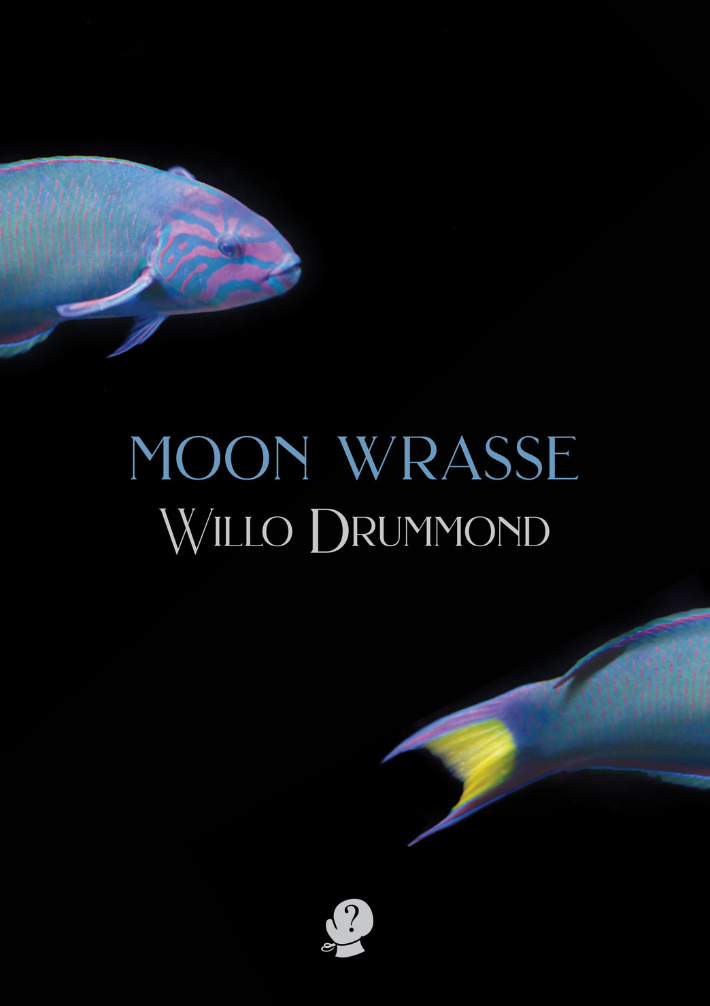
Moon Wrasse
The Lyric Tension
The world is holding its breath. Everything is moving into positions of intense gravity: the waves in a mangrove swamp—imagine it, it’s still half-way possible—are knocking against the trunks with an extra pointedness, like a second, deliberate knock on your bedroom door. The bees are slightly louder, if only because you know you may never hear them afterwards. If, as Timothy Morton says, the climate collapse is a ‘Hyperobject’—a Thing too vast, multi-faceted and horrific for the limits of neo-liberal discourse; at the same time, the perfect product of neoliberal capital—there is an obvious value—or market—to poetry that sifts this hugeness, reroutes it through different channels, so it can be dissolved into a form-of-life (a gesture, a form of organising, a joke, a bodily habit) that might interpret / transform / divest it. As Moon Wrasse by Willo Drummond demonstrates, this doesn’t have to imply a specific ecopoetic, or fall under what we call eco-poetry. As her poem ‘Seed’ states:
Here in the interstitial
(7)
here in the lyric tense
she stills to witness
each furred pod
gain its wild purpose—
The question is less what writing in a specific eco-poetic register implies, and what resources lyric poetry / the lyric mode can bring to bear on such a register / on the world, as it exists ecologically at a shitfucked junction of time. What means does the lyric have to connect Drummond’s subjects—familial grief, transformation of the speaker’s identity, the possible gap felt when a partner begins HRT, the speaker’s changing sense of the relationship as a cis person, what is opened up—to the backdrop of the climate crisis / a store of ecological imagery and poetic solutions, without appropriating the scope of the catastrophe for one’s own chamber play? How do these subjects / poems mutate, lyrically plugged into this huge engine? What does the lyric mode become, what does it do now, as the universal crisis plays out?
It’s worth asking what the lyric even does in the first place, or at least what it can do in this situation. If the climate crisis is a program, breaking down following its own unchanging historical logic / junk code, reaching after some auto-generated end that will never be adequately present, Drummond reworks lyric poetry’s negative capacity—its “being in uncertainties, mysteries, doubts, without any irritable reaching after fact and reason”, according to Keats (277)—to put this program on pause. If revolution—for Walter Benjamin—was a way of pulling the emergency brake on history, of creating a break in which the potential for a radical reworking of the world becomes actionable—Drummond tries to achieve something similar on the atomic level of language.
The lyric mode—for Drummond—becomes a way to decouple language from its enmeshment in the program destroying the world / destroying the possibility for lyric poetry in the first place. In this regard Drummond’s sense of lyric poetry is highly recursive, commenting and elaborating on its own capacity for the labour of poetry while addressing its given subjects—“to build another bed / simply for the act of making” (12). The aim is less a defamiliarisation of language than the sense that language is only explorable as an object / phenomenon in the stillness that lyric poetry is placed to create, in the breakdown in causality it can effect. It’s in this stillness—Drummond posits—that allows a lyric poem to be ecological: to be transformed by an ecological sensibility + circuit of reference, rather than its enmeshing in the machinery of linguistic capital: each furred seed gaining its own purpose beyond a language’s sense of what ‘Purpose’ entails. By a similar token, the character of the lyric poem / its speaker changes: instead of actively evoking the poem, adamically speaking it into being, the details of the ecological world are heard / witnessed— “a life of Awe”, as Drummond calls it in the poem ‘Cedar Tree’ (33)—refracting in the prisms of poetic language that Drummond makes for them. Writing in this lyric stillness, removed from ‘history’ except for where it intrudes in specific, positivised details—Drummond speaks of California fog masking “Silicone, dairy-free yogurt, politesse and privilege” (29), as well as in the poem ‘Rambler’:
I pass a new-age
(39)
dog-walker:
...
a surety at home in Hainault
Country and Seven Kings. Fluorescent
hi-tops, leopard skin
knickerbockers, tied at the knee;
The effect, at its best, is genuine highwire: Drummond uses the tools of lyric poetry— strategic enjambment to split the sense of a phrase apart, negative space to draw attention to how a word is being contextualised, metaphor where the whole idea of metaphor and what makes it possible is in abeyance—to put itself under erasure. The poetry is in holding the two poles of a contradiction—the fullness of the poetic act and how the poetic act is empty in itself—apart—in lyric stillness / tension—to draw attention to how language functions to re/produce a sense of inter-subjectivity, how that intersubjectivity is captured, how / in connection to what it may open itself on its own terms. It’s a poetry that—in order to navigate this stillness, its sense of inter-subjectivity, contradictions frozen like dinosaur skeletons—necessarily invests a premium on the ethical, and the development of an environmental / poetic ethic as the subtext of the poetry as a whole. Drummond draws on Denise Levertov and Rilke—poets excavating subjectivity to the point it sheds its traditional ground in the Human Subject, remaining attentive to That Which Shines Through—to elaborate this ethic, and through it a way to navigate the stillness the lyric brings without compromising its potential. Nouns and verbs like ‘being’, ‘Thing-like solitude’, ‘witness’, ‘longing’, as well as the generalised / metaphorically charged appearances of rocks, water, birds and air gain specificity they otherwise would have lacked, becoming resonant the more the poems draw from the same stock of imagery and touchstones.
That said, the need to reach this kind of compromise with the lyric—its stillness—points at a problem that Drummond never entirely succeeds at resolving. The use of the lyric allows for a suspension of referentiality when it comes to language, creating a space for a true eco-poiesis: the poem as a vessel / instrument through which the wind blows. At the same time, this never applies to the lyric mode itself, in the elements that Drummond jerry-rigs out of history, a history that has specifically been banished; the animating force of the poetry is extrapolation away from this axiomatisation of the lyric, in order to make the rest of the poetry work. A strict, arbitrary division between the lyric as a mode and what it is used for is established. As such, the ecological-intersubjectivity of the poems, as well as their ethical imperatives, end up having to pull double-duty papering over these facts.
The basic contradiction of the poems—using the lyric mode to write poems about the insufficiency of the lyric mode and its forms—threatens to undermine their basic conceit, the stillness which prevents a broader historical reference, which Drummond’s extrapolation of the lyric is ill-suited to address. Hence the emphasis on ethics and intersubjectivity, as well as the abstraction that can come across in the poems’ language. Drummond is aware of this, continually pushing back against this problem, the self-limit placed on the poems by themselves. Breath and breathing out figure in the bodies and the ends of Drummond’s poems—“so much is pneumataphoric metaphor / and urban, suburban, sub-sub urban transpiration” (16)—the empty space of the page made equivalent with an exhalation, a natural resolution, letting everything sit unresolved. Edge cases recur in the poems, literally and formally: tides edge in, the edge of the world appears in speech, bees and other animals “hover, uncertain what to make of such circuitous traversings” (11), marking the edge of the lyric voice, the speaker’s remit and the subjectivities accessible to the poetry.
Drummond’s poems conclude open-endedly, on an image of the poem’s necessary incompleteness, a gesture toward the self-referentiality of the poems and beyond the limits set for them. In this it extends the technique of enjambment Drummond has already used to draw attention to the negative space of the page / poem, to situate the tension of the lyric in a nebulous beyond that only the ethics developed in the poems can account for, that only from this language of ideal stillness and attentiveness can a true eco-poetics / language adequate to our historical conditions be derived. By a slight of hand, the lyric ends up doing what the poems themselves seem to dread: creating a language through which the natural world, in its condition-beyond-language, is recuperated to a limited / limiting voice. The terms of its transformation end up fastened to a language that—in the fixed relation of ‘witness’—ultimately throws up its hands at the world; what a poetic feedback between ecology and poetry—not only according to the lyric—might reassemble, or disassemble.
Works Cited
Keats, John. The Complete Poetical Works and Letters of John Keats. Read & Co Books, 2008. Originally published by Cambridge Editions, Houghton, Mifflin and Company, 1899.
