


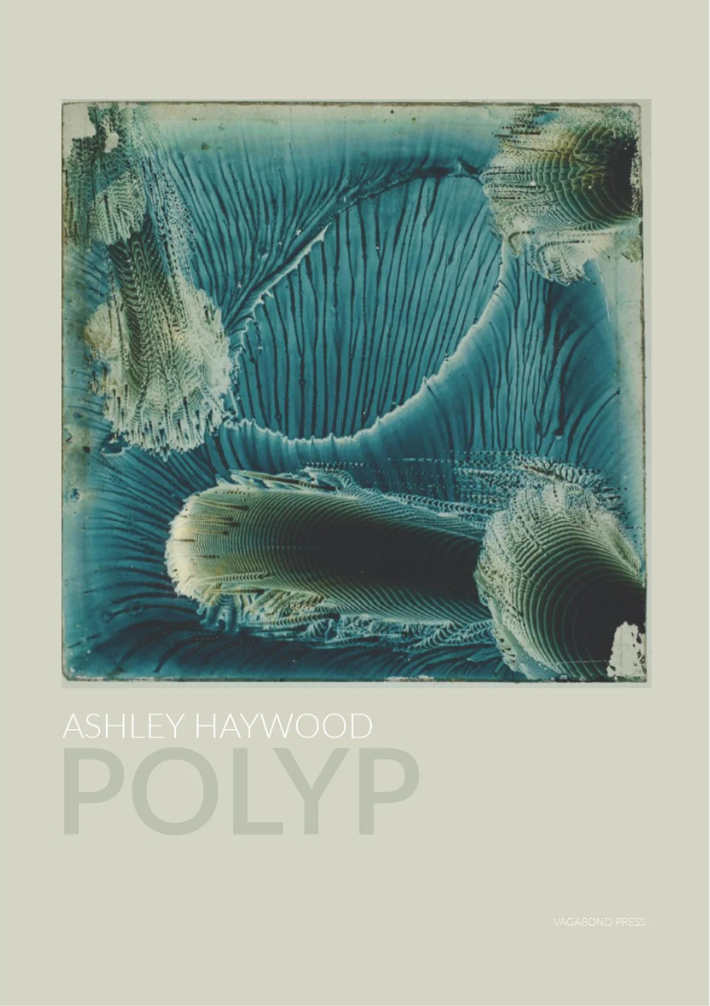
Polyp
About a quarter of the way through Ashley Haywood’s Polyp, a poem arrives that provides decisive illumination and clarity regarding the philosophical, ecological and existential questions, and sheer epistemological scale, of this debut collection. The poem is ‘Shadowtime in the Eromanga Sea’. The Eromanga Sea was a shallow inland sea that covered vast areas of central and eastern Australia during the Cretaceous period. This phenomenon itself is an indication of Haywood’s literary concerns, but it’s the idea of ‘shadowtime’ that is particularly resonant in shaping the context and framework to inform a close reading of Polyp as it unfolds.
According to Haywood’s extensive notes at the back of Polyp, ‘shadowtime’ refers to “the sense of living in two distinctly different temporalities at the same time; e.g. a ‘shadow’ timescale in parallel to the present day” (61). ‘Shadowtime’, first used in 2015 by artists affiliated with The Bureau of Linguistical Reality (BLR), a participatory artwork led by Heidi Quante and Alicia Escott, is deeply entwined with the human perception of the climate crisis. The term refers to the awareness that as we go about the daily duties of our domestic and professional lives, “there is a creeping sense of concerns that would make all said planning obsolete or seem unimportant”. It might occur “when one is preparing a meal for their child and suddenly realizes that an endemic flower that had evolved over 42.7 million years has gone extinct within their child’s lifetime” (Mukherjee and Escott).
The work of a compellingly unorthodox poet who experiments with form, format and voice in a way that combines human intimacy and compassion with the taxonomical terminology and systematic rigour of science, Polyp flows in many directions across many concepts and theories relating to Earth’s geological time scale and the impact of the Anthropocene. Yet it is ‘shadowtime’ that offers a thread that makes reading Polyp an enriching and somewhat sobering experience, preoccupied with both beauty and decay and extinction as it is. In ‘Shadowtime in the Eromanga Sea’ she writes:
Sandstone hollows out over time
like thirst. Canvas
on my back hardens
into shell my ear flattens
as foot-tongue
(23)
Polyp follows BLR’s definition of ‘shadowtime’ with poems such as ‘Mudlark’ and ‘Understory’ (its title alone surely a reference to ‘shadowtime’) that address aspects and landmarks of an individual’s life—the death of a grandmother and reflections on a child respectively in those two poems—alongside observations of the “long-moan eddies” (17) of time, as ‘Mudlark’ puts it. That poem even draws on the concept of Chaos, the void state prior to the birth of the universe according to Greek myth, as it reflects on a deceased grandmother’s tea towels and bedside table. In close to a dozen poems, the majority of which contend with biological and geological evolution, there appears to be two timespans embedded in their imagery and narrative.
Based in Kau-in Kau-in/Redcliffe, Haywood’s understanding and preoccupation with deep time was forged by an immersion in the work and papers of the pioneering Australian paleologist and geologist Dorothy Hill, as part of a writing fellowship with The University of Queensland’s Fryer Library. Hill’s seminal work on coral and coral fossils has been globally influential (the collection’s title, Polyp, refers to the individual animals that make up coral). Hill broke new ground for women in science and is especially known for research on the Paleozoic Era, which began 539 million years ago. In 2019 Haywood told the ABC that Hill helped her grasp ungraspable time (“‘Geopoetry’ Inspired by the Work of Australia's First Female Professor”). Such a concentrated engagement with time (the word almost feels inadequate in this context) must surely have had a profound impact on Haywood’s psyche, as well as her work.
Haywood’s interest in deep time has a particular focus on death and dying, which might be better understood as non-existence or non-time. Polyp confronts death in enlightening and imaginative ways, and in certain poems Haywood moves away from any scientific language towards something approaching a framework of spirituality that is vaguely Gaia-informed. ‘The Lure’ is a significant poem in this regard. As Haywood writes in the book’s notes, which offer almost as much an insight into her poetics as the poems, this work is about the Pisonia or bird-catcher tree on Heron Island that attracts fledgling terns with sticky seeds, which ultimately strand the birds with their weight, killing them:
bird-catcher trees
flare like polyps—seed-
hooks to eyes, line-
loops beyond
head: baitrib-spinner!
(13)
These agile and playful lines are contextualised by Haywood’s comment in the notes that “these bodies nourish the island’s soil while others survive to disperse seeds” (60). This perception of a circular flow of life and death, and the idea of death serving an interconnected whole, returns with the spectacular ‘The Mudeater, the Fossil and the Hagfish’. This explicitly Hill-inspired work, with its vaguely Lewis Carroll-esque title, is among Polyp’s several highly dextrous sequenced poems that reward re-reading. The stanzas about the hagfish, a bottom-feeder prone to eating its prey from the inside out, warrants an extended quotation:
I can trace my linage back to the jawless—
a hagfishwho survived the surge
who is destined
with slit mouth
with rasp of tongueto feed on the dying and the dead.
I left the sea to stand on my own two legs—
it’s in my blood
to excavate—
to eat and eat and eat.
(31)
The hagfish and the Pisonia tree may seem brutal, but in Polyp they become sublime and essential evolutionary pinions, contributing to a greater harmony that may be beyond our perception. In ‘Waterborne’ Haywood writes “everything is / thread” (52, italics in original), a poem that also declares “a quiet seed is ritual / in folds” (51). Amid the devotion to Hill and earth sciences, a discernable spiritual schema is identifiable throughout.
Another question that Polyp confronts as it considers time on such an expansive, cosmic scale is where poetry and the poet fit in this conception of time. One answer might be that the poem becomes a beyond-infinitesimal event, and certain poems do opaquely hint at this, such as ‘Salt Lake’, which considers the erasure of personhood in the context of deep time as a poet figure appears to be subsumed by the Kati Thanda (Lake Eyre) landscape. Another is ‘Night Window’, in which “A meteor / or rain drop falls right through me— / head to toe” (21).
Though obviously dealing with vastly different imagery and subject matter, such poems briefly bring to mind George Oppen’s ‘Five Poems About Poetry’, or to a slightly lesser extent Marianne Moore’s ‘Poetry’, both works of ars poetica that express a certain mild contempt for poetry, and literary effort generally, in the face of more imposing and universal questions (or disasters). While Polyp is certainly actively seeking where the poem might find traction amid both the unknowable abyss of time and contemporary impending climate collapse, you could never say Haywood is anything but enthralled with the possibilities of poetry and invigorated by the act of writing. Which brings us to how the poet has presented her poems on the page: specifically the use of punctuation, space, line-breaks, syntax, casing and typography.
The first half-dozen poems in Polyp are frankly dizzying in their presentation. Opening poem ‘Ars Polyp’, for example, toys with words in all-caps and in italics, both curved and squared brackets, and hyphenated words that are split between lines. As the poems continue in this vein, it may take the reader time to orient themselves to the poems’ busy punctuation detail and page sprawl, but eventually a pattern emerges—one that returns us again to the concept of ‘shadowtime’. Italicised words are employed in many poems and while the intention behind this is not always clear, in some instances the italicised sections become a second, or subsidiary poem when extracted from the text: a proverbial poem within a poem. This occurs fairly explicitly in ‘Mudlark’, a sequence poem that elegises Haywood’s grandmother. In the first section the italics create the micro-poem “Welcome to … pure Irish … linen … Made in … outback” (14). Out of ‘Waterborne’ comes “under … earth … everything is / thread” (51-2); and ‘Understory’ “I … this … this … is … my son” (53). This formal innovation is an echo of ‘shadowtime’: two statements or narratives existing in parallel within one poetic scaffolding. This device is, however, established quietly throughout Polyp—it is only in ‘Mudlark’ that it jumps off the page—a reflection of Haywood’s poetic restraint and sensitivity, and the meditative calm that ripples through many poems.
Another aspect of Haywood’s approach to the shape of poems emerges when you consider she has completed a PhD in creative research that explored “how to write like painting”, as her biographical note states. This idea can be interpreted in numerous ways, but based on how Haywood has crafted the poems in Polyp, it seems this relationship arrives with the reader’s initial act of ‘looking’ at the poem on the page. That is, some poems give a vivid impression with a first glance at them—in terms of their bend and sprawl on the page as well as the linguistic tone and choice of words and punctuation—that mimics the moment you place eyes on a painting for the first time, seeking a general impression before moving on to detail. This may not exactly constitute concrete or visual poetry, but it does invite the reader to consider poems in a non-linear fashion, and not necessarily from left to right, or top to bottom. Poems effective with this aesthetic in mind include ‘Understory’, ‘On a Long Walk Away from Away’ and ‘Portraits’.
To return to the question of where poetry might exist in Polyp’s colossal time scale, it is worth reflecting on how Haywood considers perspective and subjectivity in her poems, or more specifically, to what, or who, her ‘I’ refers. As the back cover states, this I is “desirous of multiplicities, time-fullness and connection”. Sometimes the I appears to be a straightforward, observational, egoic presence: ‘Shadowtime in the Eromanga Sea’ and ‘The Tableland Hour (2)’. But elsewhere, it is almost as if the I emerges from the fault lines of the earth—geology and geography given voice. Another reading of ‘Salt Lake’ is that it is Kati-Thanda itself expressing its desolation—“I cough up / mummified leaves, stone / seeds—the forest is gone.” (10) ‘The Wetland’ presents an ecosystem in “a mess”, yet “Grey matter hums beneath still-/life” (26). It is interesting also to note that in the collection’s first half, the I is on a large scale: full landscapes and landforms assuming a tongue (a tongue is a frequent image in Polyp, most wonderfully in ‘The Tableland Hour (2)’ where the shape of a murmur of birds is compared to one). In contrast, by the volume’s last few poems, we are in the domain of the small (to human perception), swarming and indestructible: cockroaches and silverfish, for example. ‘Complex Cells’ and ‘Small Dance’ are almost odes to the minute but perfectly evolved. These insects, of course, exist in their own time identity, expanding the range of temporal perceptions that are acknowledged in Haywood’s poetry.
Cockroaches, as we are consistently told, will apparently survive the nuclear apocalypse, and certainly will continue to thrive amid climate collapse. Polyp concludes with the poem ‘Glass Slide; or, As I lay down in the instant’, which offers a reconciliation, renewal, and unification through a return to the ocean:
Lost to time. Beneath the surface
fish fly over me—
my ribs break open! Coral grows
wildly from bone.
(58)
These lines suggest Earth’s resilience, but humanity’s extinction. A profound instance of rewilding. When taken alongside the durability of the insects, Polyp leaves the reader with the sense of a second concept defined by the BLR: ‘epoquetude’. This is defined as an acceptance—or a “reassuring awareness”—of the knowledge that even if humanity eliminates itself, the planet will live on (Discenza). Another moment of illumination: the smallness of poems, the poet, language and indeed, people, is something we can be at rest with.
Works Cited
Discenza, A. “Epoquetude.” The Bureau of Linguistical Reality, www.bureauoflinguisticalreality.com/portfolio/epoquetude/, Accessed 1 February 2025.
“‘Geopoetry’ Inspired by the Work of Australia’s First Female Professor.” The Science Show, ABC Radio National, 9 Feb. 2019.
Mukherjee, R and Alicia Escott. “Shadowtime.” The Bureau of Linguistical Reality, www.bureauoflinguisticalreality.com/portfolio/shadowtime/, Accessed 1 February 2025.
