
Kangaroo Paw
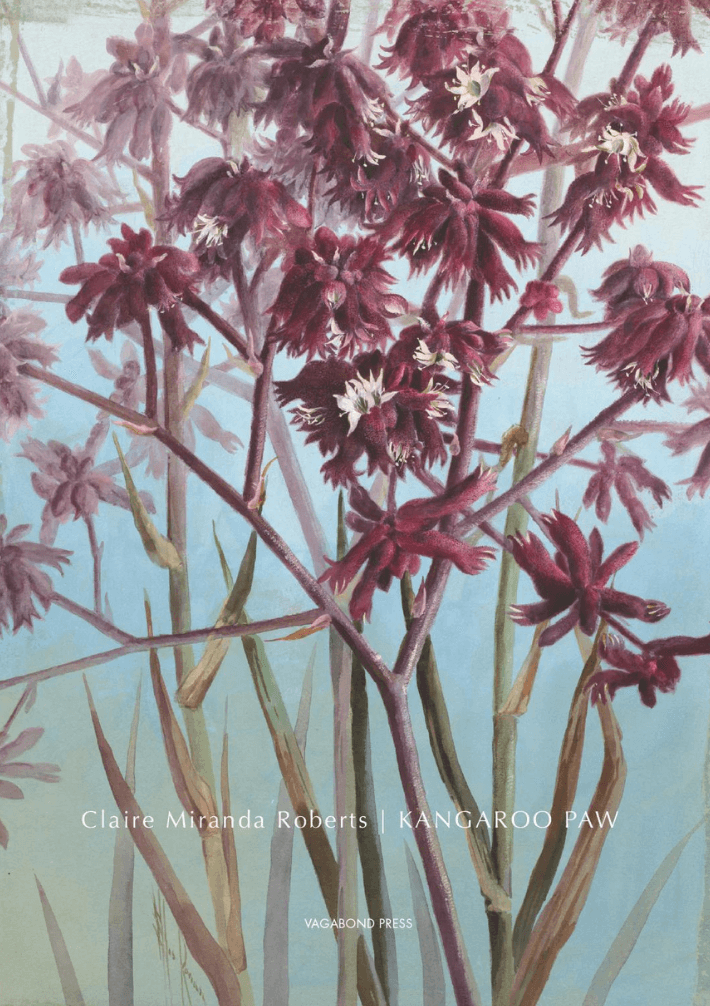
What struck me most reading Claire Miranda Roberts’ Kangaroo Paw was how simply the collection is packaged. There’s Roberts’ minimalist titles, for instance—‘Stones’, ‘Tides’, ‘Banksia’, ‘Window’, ‘Coastal Banksia’, ‘Water Flower’, ‘White Jasmine’, ‘Leatherwood’. There’s the length of the poems, most of them under half a page, and the spare botanical art on her front cover. I expected a certain kind of light reading from this collection at first, a series of straightforward, descriptive nature lyrics. Kangaroo Paw performs its complexity quietly. But its ironies, its subtle experiments with language and form, accrue.
Roberts is trained as a visual artist. We learn in the afterword that she studied still-life at the Victorian College of the Arts before practicing poetry; Kangaroo Paw is her first collection, and the influence of her background in art is clear. Almost all the poems are committed to examining a species of Australian flora after which they are titled. The majority of these are flowering plants, some native to Australia—especially Victoria, where Roberts lives—and others, like the star magnolia, iris and camellia, introduced. In between are poems on water, orchards, lyrebirds, and the poet’s search for her maternal lineage in early colonial Tasmania, archival research she documents on her blog, The Other Beauty. The poems in Kangaroo Paw can certainly be read as ‘portraits’ of a kind; they were described as “miniaturist artworks” by the judges of the Victorian Premier’s Literary Awards, for which the collection was shortlisted in December last year. But what Roberts seems to take from art more than anything is an active scepticism of representation, an awareness of the role that both art and literature have played in flattening nature into a resource for instrumental use. If these are portraits, they gently resist the many frames in which the natural world—and perhaps especially the flower, that persistent symbol of national identity or romantic truth—has too readily been captured.
Roberts’ syntax is one of the more fascinating aspects of the collection. Not until my second reading did I appreciate just how difficult it sometimes is. Individual words tend to be multiply determined—like some kind of lenticular artwork, the meaning of a clause can change depending on which version of a word one sees. Here is the first poem in the collection, ‘Armillaris’ (on the commonly known bracelet honey-myrtle of south-eastern Australia), which I read many times in an attempt to nail down where, exactly, the titular flower is:
The clasps
(9)
of calyx branches
wooded weight upon
duplicate saplings
are shyness—
the extension of politeness
to a stranger.
Is the “shyness” in ‘Armillaris’ the “duplicate saplings”, or the “wooded weight” that bears upon them? And “wooded weight”—am I reading that properly, or is “branches / wooded” its own image, unrelated to “the clasps / of calyx” and the “weight” on either side? Three words in this poem could read as nouns or verbs: “clasps”, “branches”, “duplicate”; Roberts’ syntax is so unresolved as to allow both possibilities. This technique repeats in other poems, each time to beautifully strange effect. In ‘Australis Indigo’, “the impression of / liquid / pouring over / rock forms” is a clear enough clause until “forms” loosens from “rock” and takes on meaning as a verb (as in ‘Armillaris’, the two words are separated by a long space in the middle of the line). The relationships between things are vague in these poems, as are the forms and meanings of the flowers at their centre. At times they reminded me of the work of the artist Michael Flomen, whose cameralass ‘nature’ photographs—made by exposing photosensitive paper to the various movements of light, wind, leaves or insects over several hours—leave us similarly unsure where precisely an impression is coming from. While Roberts’ titles promise a series of loco-descriptive portraits, it is often hard to tell in Kangaroo Paw what we are looking at, from what distance and for what duration, and on which of her possible meanings to decide.
There is a tentativeness, a protectiveness, about these poems. “I want to hide the water / flower”, Roberts writes of the lotus that “unfastens / soundlessly” and “bend[s] into surface”, “to prevent it from being / seen, the experience of being defamed / or written too clearly” (‘Water Flower’, 37). There is also a feeling of belatedness, this being the only way I can think to describe it; we sense the poet has arrived too late at the ecological event—the “frayed / flower spikes / turning to rust” (27), the “aerial / ferns that bud / with scarlet / epiphytes” (28)—to assign it meaning. Roberts deploys a kind of bathos at the end of many poems to convey this, often using an em dash to divert her first stanza before landing on an image that feels suspended or incomplete. Here, for instance, is ‘White Jasmine’:
If I stay long enough
(18)
I may become
everything around me: many
pinks
in the dusk
white jasmine appearing
like brooches on the timber—
the fragrance
on the air stopping.
Several other poems in the collection conclude this way: from the first stanza of ‘Banksia’ (“pink and golden / cobs that float and puff / coarse nets around linear stems—”) Roberts cuts to and ends on a simple statement of the flower’s tolerance for cold (“bear a talent for frost / and long absences”) (20). In ‘Kangaroo Paw’ we sense she is quickening, gathering momentum towards a proper revelation of the titular flower (“the division of / extremities under / the pain / of frost / change colour rapidly—”) but she disappoints with her subtle ending, where the kangaroo paw merely “fall[s] dormant / interior and oblique” (21). “The fragrance / on the air stopping”: we sense in these lines a totality that resists the poet. Whatever meaning we expect her to find in the jasmine appearing in the dusk or in the “hair-like pigment” of the kangaroo paw (21), her language has arrived too late. This is the “life / below life”, as Roberts puts it elsewhere (32), a reality that precedes language. The banksia’s “talent” for survival, the impression of jasmine “stopping” on the air: the poems end by describing only what they can.
Some of the poems in the last stretch of the collection give Roberts’ project more urgency. Here she attempts a slightly riskier engagement than in the flower series; the poems are longer, more allusive, and speak more directly to the kinds of violence her ‘portaits’ seek to resist. ‘The Orchardist’, for instance, a particularly brilliant and complex poem, plays with quotes from Sam Van Aken, the American artist behind The Tree of Forty Fruit—a real, hybridised and reproducible fruit tree currently available for private purchase in the U.S. for $30,000. Roberts shows elegantly the dualist logics behind this project, which Van Aken chose to bear exactly forty varieties for its “biblical significance as a number that points to the infinite” (Speach 2017). “We can collapse a whole orchard / by injuring the tree, / so that twenty varieties grow on a single branch”, she writes. “By timing the injuries precisely, / we reach the number forty” (48). The unruly orchard that “looks for light” in the poem is “trained” by the artist, so that “law”—and, Roberts suggests, art itself—may “administer” over nature’s excess:
the blossoms display countless tones of crimson
(49-50)
in a stunning division from chance,
phenomena trained
so that law finally may bear children
and administer over trees.
There are so many poems in this collection that deserve close, careful reading. ‘Witness’, a partial cento on the introduction of a population of superb lyrebirds to Tasmania in the early 20th century, plays with descriptions of colonial art taken from the Victorian Collections Digital Archive. While the scene these conjure is painterly (“sunlight filters through venerable tree ferns”, “the lyre fans in a corsage of white fronds”), Roberts ensures, as she does in ‘The Orchardist’, that a sense of damage, along with an absence of human witness, emerges. “Who bears witness”, the poem opens, a single, one-line sentence. Elsewhere she evokes “the once-green furrows”, “the birds and trees in broken silences”, against which the “psalm” of the lyrebird is heard (44-45).
Much has been made of the idea of the radical in recent ecopoetry criticism. Scholarly work of the past decade has been particularly set on shifting ecocritical attention toward experimental or avant-garde poetics, and away from the conventional nature lyric that is still the most widely read of our eco-forms. Kangaroo Paw is probably not ‘radical’, at least not in the ultra-deconstructive, late-century-Language-poem sense this term often implies. Roberts aims toward a more genuine form of witness, not only of the natural world itself—whose phenomenal realities clearly fascinate her—but equally of its troubled use in the very traditions of art and literature that, as a trained artist and obvious poet of nature, likely still inspire her. There’s skill in how quietly the poems stage this reckoning, how carefully the reader has to look. And meanwhile the primariness of natural life stirs slightly, partway visible, but never finally in the poet’s hands: “the flower of one species / takes the leaves of another” (35); “I look down and glimpse / a snowy bud / mirrored on the water / before I can cross / back to where I stand” (47).
